
Following the “money” when trying to better understand the commodity markets is crucial. When we refer to the money we are talking about the Managed Money. As per CFTC (Commodity Futures Trading Commission) glossary of terms the MM are a group of futures market participants who engages in futures trades on behalf of investments and / or clients. They are usually equated with hedge funds (funds) but may include commodity pool operators (investment trusts for example).
For simplified understanding the funds have a collective pool of money, this is usually significant amounts of money and is where there purchasing power makes them so crucial players within the commodity markets.
The CFTC release a weekly report titled the commitment of trader (COT) which is designed to help the public understand the dynamics of the markets. The report provides a breakdown of the previous Tuesday’s open interest for futures and options in which 20 or more traders hold position equal or to above the reporting levels.
Our focus will be on the disaggregated futures and options combined long format agriculture report (screenshot below). The long and short formats have been explained below.
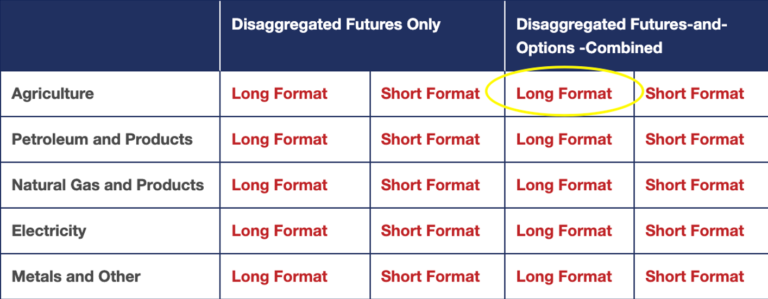
Short report shows reportable open interest and week-to-week open interest changes separately by reportable and non-reportable positions. For reportable positions, additional data is provided for commercial and non-commercial holdings, spreading (in certain categories only), changes from the previous report, percent of open interest by category, and numbers of traders.
Long report, this groups the data by crop year and shows the concentration of positions held by the largest four and eight traders.
Full details of each category contained within this report can be found using the CFTC website, but we have also provided simplified terms for ease of understanding below:
Producer/Merchant/Processor/User: Any entity that that predominantly engages in the production, processing, packing or handling of a physical commodity. Producers will be the farmers in various countries, and they will use the futures markets to manage or hedge risks associated with those activities. The producer will predominately sell their products to a merchant who will handle the resale of the packaged materials from the producer and markets this the open market.
Swap Dealer: A “swap dealer” is an entity that deals primarily in swaps for a commodity and uses the futures markets to manage / hedge their risk associated with those swaps’ transactions. The swap dealer’s counter-parties may be speculative traders, like hedge funds, or traditional commercial clients that are managing risk arising from their dealings in the physical commodity.
Money Manager: A “money manager,” for the purpose of this report, is a registered commodity trading advisor (CTA); a registered commodity pool operator (CPO); or an unregistered fund identified by CFTC. These traders are engaged in managing and conducting organised futures trading on behalf of clients. Other Reportables Every other reportable trader that is not placed into one of the other three categories is placed into the “other reportables” category.
The Disaggregated COT sets out open interest by long, short, and spreading for the three categories of traders—“swap dealers,” “managed money,” and “other reportable.” For the “producer/merchant/processor/user” category, open interest is reported only by long or short positions.
Spreading: A computed amount equal to offsetting long and short positions held by a trader. The computed amount of spreading is calculated as the amount of offsetting futures in different calendar months or offsetting futures and options in the same or different calendar months. Any residual long or short position is reported in the long or short column. Inter-market spreads are not considered.
Numbers of Traders: The sum of the numbers of traders in each separate category typically exceeds the total number of reportable traders. This results from the fact that, in the “swap dealers,” “managed money,” and “other reportables” categories, “spreading” can be a partial activity, so the same trader can fall into either the outright “long” or “short” trader count, as well as into the “spreading” count. Additionally, a reportable “producer/merchant/processor/user” may be in both the long and the short position columns.
The discussion forum below was created to exclusively talk about questions associated to money flow. If you have questions about this topic, don’t hesitate to start a new discussion below.